
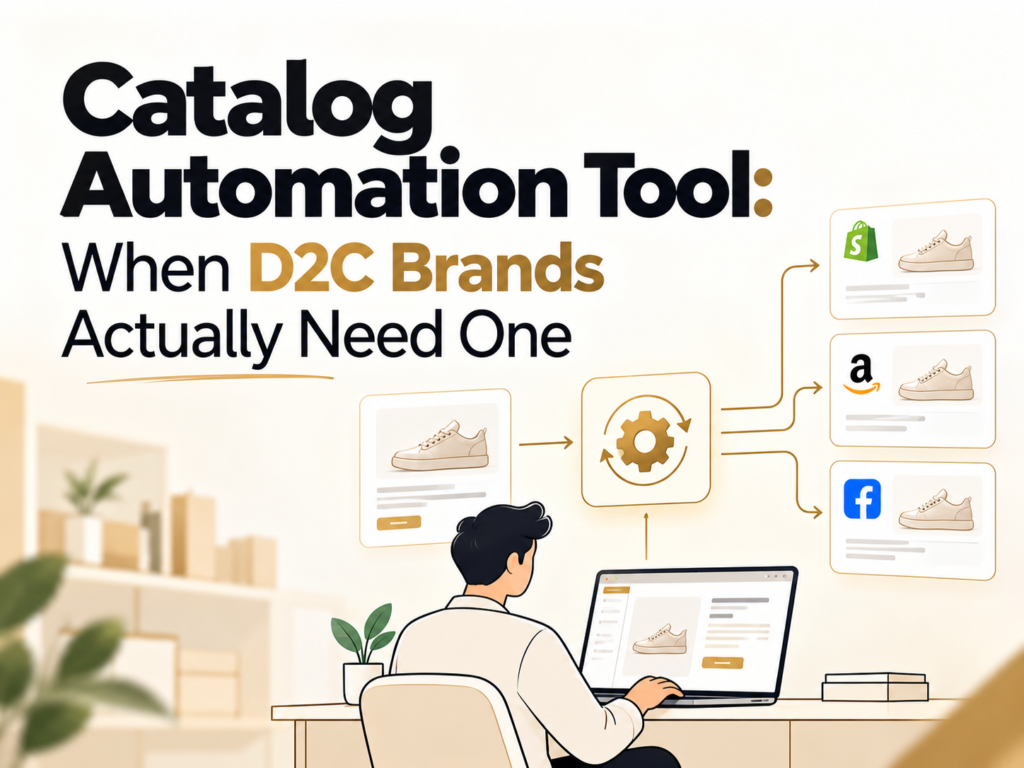
TL;DR: A catalog automation tool becomes worth it once you are manually updating feeds every week, seeing ad disapprovals from feed errors, or managing more than a few hundred SKUs across Meta and Google — the earlier you adopt one, the less ad spend you waste on stale data.
ON THIS PAGE
A catalog automation tool becomes essential for many D2C brands right around the point where manual product feed management starts breaking down. If your brand just crossed $1M a month in revenue, you have probably started wondering whether a catalog automation tool is worth the investment. This guide walks through exactly when you need one, and how to choose the right catalog automation tool for your stage.
At Fennel Infotech, we help scaling D2C brands connect Shopify with the catalog and ad systems they need, including choosing and setting up the right catalog automation tool.
What Is a Catalog Automation Tool?
A catalog automation tool automatically syncs your product data, pricing, inventory, and images across advertising platforms like Meta and Google, instead of requiring manual feed updates. As your catalog grows, a catalog automation tool becomes the difference between accurate ads and constant errors.
What a Catalog Automation Tool Typically Handles
- Cross platform syncing — product data flows automatically to Meta, Google, and other channels
- Real time pricing and stock updates — no more manual spreadsheet edits
- Feed error fixes — catching the issues that block ad approval before they cost you
- Automatic segmentation — products sorted into the right campaigns without manual tagging
- Seasonal pricing rules — promotional changes handled on autopilot
Signs You Need a Catalog Automation Tool
Many brands wait too long before adopting a catalog automation tool, which leads to wasted ad spend and manual errors. Watch for these signs.
- Weekly manual updates — you are touching product feeds by hand every week
- Rising ad disapprovals — feed errors are getting flagged more often
- Catalog past a few hundred SKUs — manual processes stop scaling around this point
- Pricing or stock mismatches — ads showing outdated information
- Hours lost to catalog fixes — time that should go toward strategy instead
⚠️
Manual feed updates quietly cost hours every week, and errors often surface as disapproved ads rather than an obvious warning sign.
✅
A catalog automation tool catches pricing and stock mismatches before they ever reach your ad accounts.
Catalog Automation Tool vs Manual Feed Management
| Factor | Manual Feed Management | Catalog Automation Tool |
|---|---|---|
| Time required | Hours per week | Minutes for review and setup |
| Error rate | High, especially at scale | Low, with automated checks |
| Update speed | Delayed, often batch based | Near real time |
| Scalability | Breaks down past a few hundred SKUs | Handles thousands of SKUs easily |
How to Choose the Right Catalog Automation Tool
Not every catalog automation tool fits every brand. Before choosing one, consider the following.
- Shopify integration — does it connect directly to your store?
- Multi platform reach — can it push to Meta, Google, and other channels you use?
- Rule based segmentation — does it support different rules for different campaigns?
- Ease of setup — can you maintain it without a developer on call?
- Pricing at scale — what does it cost as your catalog grows?
What Happens If You Delay Adopting a Catalog Automation Tool?
Delaying a catalog automation tool usually means continued manual work, more feed errors, and wasted ad spend on outdated pricing or stock information. As catalog size grows, these problems compound quickly. For the broader picture of what to fix before scaling ad spend, our guide on scaling a D2C brand from $1M to $10M covers the operational side in more depth.
Is It Time to Switch?
- Catalog under 100 SKUs
- Feed updates take under an hour a week
- No recent ad disapprovals from feed issues
- Pricing rarely changes
- Single ad platform in use
- Catalog past a few hundred SKUs and growing
- Multiple hours a week spent on manual updates
- Recent ad disapprovals tied to feed errors
- Pricing or promotions change frequently
- Running ads across more than one platform
Setting Up a Catalog Automation Tool: What to Expect
- An initial audit of your existing product data and feed structure
- Mapping product attributes correctly across each ad platform
- Setting automation rules for pricing, stock, and promotions
- Testing feeds before going live across ad accounts
- Ongoing monitoring to catch new errors early
We help D2C brands choose, configure, and maintain the right catalog automation tool alongside their Shopify store and ad accounts — our team handles the technical setup so your product data stays accurate as your catalog grows.
Frequently Asked Questions
At what revenue stage do I need a catalog automation tool?
Many brands start needing a catalog automation tool once they cross $1M a month in revenue, or once their catalog grows past a few hundred SKUs.
Does a catalog automation tool work with Shopify?
Yes, most catalog automation tools integrate directly with Shopify to pull product, pricing, and inventory data automatically.
Can a catalog automation tool reduce ad disapprovals?
Yes, since it corrects common feed errors automatically, which is one of the most frequent causes of ad disapprovals.
Is a catalog automation tool expensive to set up?
Costs vary by provider and catalog size, but the time saved usually outweighs the setup cost once your catalog grows past a few hundred products.
Can a catalog automation tool manage multiple ad platforms at once?
Yes, most tools support syncing to Meta, Google, and other major advertising platforms simultaneously.
Do I need technical skills to use a catalog automation tool?
Basic setup usually requires some technical mapping, but most tools are designed to be manageable without a full time developer.
How quickly does a catalog automation tool update pricing changes?
Most catalog automation tools update pricing and stock changes in near real time, often within minutes of a change in Shopify.
Can a catalog automation tool handle seasonal promotions?
Yes, rule based automation can adjust pricing and product visibility automatically during sales or seasonal campaigns.
What happens if I do not use a catalog automation tool?
Without one, brands typically face more manual work, higher error rates, and wasted ad spend as their catalog grows.
Should I set up a catalog automation tool myself or hire help?
If your catalog is small, self setup may work, but larger or fast growing catalogs usually benefit from expert setup and ongoing management.
Final Thoughts
A catalog automation tool isn’t a nice to have once your catalog crosses a few hundred SKUs — it’s the difference between ad spend that works for you and ad spend quietly wasted on stale pricing and stock data. Brands that switch early tend to scale more smoothly than those that wait for the problem to become obvious.
Ready to Stop Managing Your Catalog by Hand?
- Catalog and feed audit
- Catalog automation tool setup and mapping
- Ongoing monitoring and support
- Free growth strategy consultation